

New Americans in Delaware
The Office of New Americans provides general statistics on the makeup of the State of Delaware’s immigrant community. The statistics and information provided on this page are attributable to reputable sources mentioned at the bottom of this page.
Overview (2024)
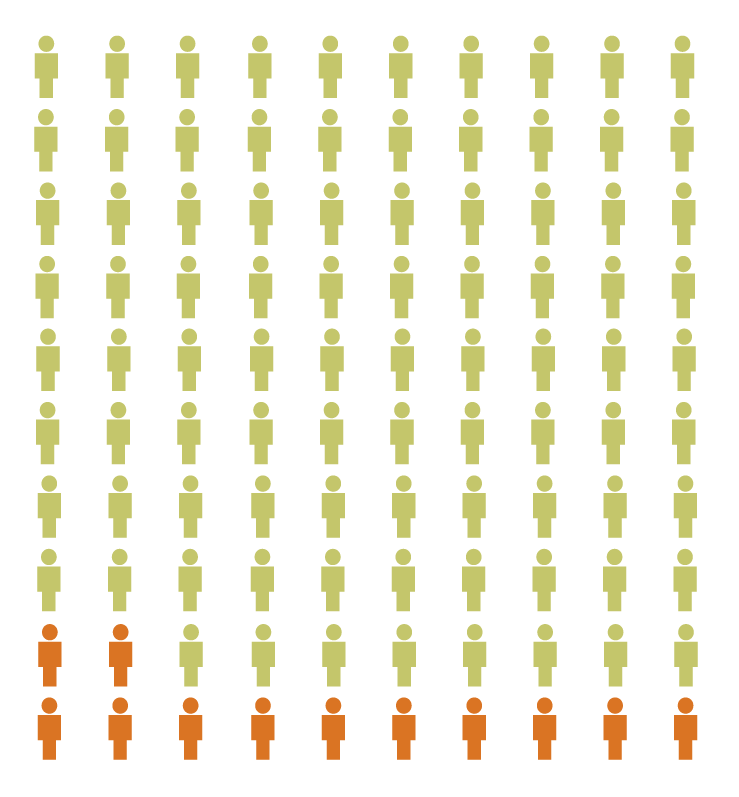
121,000+
of Delaware’s total population are foreign born. This accounts for about 12% of Delaware’s population.

$4.5 Billion
Annual spending power by immigrants.

7,000+
of the immigrant community is self-employed.

95%
of immigrants speak English.

20%
of the immigrant community have a college or advanced degrees.

$1.3 Billion
Annual combined taxes paid by immigrants.
Top Countries of Origin
15.2 % are from Mexico
11.2 % are from India
5.5 % are from Guatemala
Most common non-English Languages
According to the United States Census Bureau, 15.1% of Delaware households reported speaking a non-English language at home as their primary shared language, which is lower than the national average of 22.3%. This does not consider the potential multilingual nature of households, but only the primary self-reported language spoken by all members of the households.
In 2024, the most common non-English languages spoken in Delaware are as follows in rank order:
7.91%
spoke Spanish
5.4%
spoke Chinese, including Mandarin and Cantonese
3.87%
spoke languages of Western Africa including Yoruba, Twi, and Igbo
3.54%
spoke Haitian Creole
Other languages include:
- French, including Cajun (3.01%)
- Arabic (2.3%)
- Hindi (2.27%)
- Tagalog (2.23%)
- Gujarati (1.87%)
Education Attainment Levels
18.3%
have a graduate or professional degree
20.5%
have a bachelor’s degree
20.0%
have some college or an associate’s degree
21.2%
have less than a high school degree
Workforce Data
71.2% of the immigrant population over the age of 16 is in the labor force.
| Top Industries | Estimate |
|---|---|
| Educational services, and health care and social assistance | 26.1% |
| Professional, scientific, and management, and administrative and waste services | 14.0% |
| Manufacturing | 10.6% |
| Finance and insurance, and real estate and rental and leasing | 10.0% |
| Arts, entertainment, and recreation, and accommodation and food services | 8.7% |
| Construction | 8.6% |
| Retail Trade | 8.4% |
Refugees
125 Refugees arrived in the State of Delaware for Fiscal Year 2025.*
*Reports have only been obtained from October 1, 2024 through June 30, 2025.
| Immigration Status Upon Arrival | Total |
|---|---|
| Asylees (ASY) | 22 |
| Cuban/Haitian Entrants (CHE) | 54 |
| Refugees (REF) | 29 |
| Special Immigrant Visa (SIV) holders | 9 |
| Ukrainian Humanitarian Parolees (UHP) | 8 |
| Victims of Human Trafficking (VOT) | 3 |
Dreamers
Dreamers are undocumented individuals who came to the United States as children. Some may be protected under the Deferred Action for Childhood Arrivals (DACA).
4,000+
reside in Delaware
1,100
are protected under DACA
$75M
The amount Dreamers contribute to Delaware’s economy each year.
Temporary Protected Status (TPS) Holders
4,000
immigrants who have TPS and reside in Delaware
About 6,000
immigrants in Delaware are waiting for a decision on their asylum claim
$55M
Immigrants with TPS contribute to Delaware’s economy each year
Undocumented Immigrants
In the State of Delaware, roughly about 30,000 people are either undocumented immigrants or live with an undocumented immigrant.
11,000+
U.S. citizen children in Delaware live with an undocumented parent
1,000
U.S. citizen spouses are married to an undocumented immigrant
19,000
undocumented immigrants in Delaware have lived in the U.S. for more than 10 years
Definitions
Who is an immigrant?
An immigrant is a person who moves from one country to another country to live there permanently or for a long period of time.
Example: Someone who moves from Mexico to live in the United States would be considered an immigrant in the United States.
Classifications of Immigrants
Immigrants can be categorized into a variety of statuses. Each classification depends on the individual’s presence in the United States.
Naturalized Citizen
A naturalized citizen is an immigrant who becomes a citizen after meeting residency and legal requirements.
Lawful Permanent Resident (Green Card Holder)
A lawful permanent resident (LPR) is a non-citizen who has been granted the permanent legal right to live and work in the United States.
- A lawful permanent resident can live and work lawfully.
- May apply for citizenship after meeting residency requirements.
Non-Immigrant Visa Holder (Temporary Resident)
A non-immigrant is a person who enters the United States temporarily for a specific purpose and limited period under a visa category.
Below are common non-immigrant visa types:
- Tourism and Business
- B-1 visa: short-term business activities
- B-2 visa: tourism, visiting family, or medical care
- Students
- F-1 visa: academic study
- M-1 visa: vocational training
- J-1 visa: cultural or educational exchange programs
- Temporary Workers
- H-1B visa: specialty professional workers
- H-2A visa: temporary agricultural labor
- H-2B visa: temporary non-agricultural labor
- L-1 visa: transfer within multinational companies
- O-1 visa: individuals with extraordinary ability
Immigrant Visa Holder
An immigrant visa holder is a person who has been granted permission to enter the United States with the intention of becoming a permanent resident.
Below are common immigrant visa categories:
- Family-based immigration
- Sponsorship by U.S. citizens or permanent residents for close relatives.
- Employment-based immigration
- Workers sponsored by employers through categories such as:
Refugee
A refugee is a person outside their home country who cannot return because of persecution or a well-founded fear of persecution based on factors such as religion, nationality, or political opinion.
- A refugee applies for protection before entering the United States.
- A refugee may apply for permanent residency after living in the U.S. for a period of time.
Asylum Seeker / Asylee
An asylum seeker is a person who is already in the United States or at a border and requests protection because returning to their country would expose them to persecution.
Temporary Protected Status (TPS)
Temporary Protected Status is a humanitarian program allowing nationals of certain countries experiencing armed conflict, natural disasters, or extraordinary conditions to remain temporarily in the United States.
TPS provides:
- Protection from deportation
- Authorization to work
- Temporary legal presence
Deferred Action for Childhood Arrivals (DACA)
Deferred Action for Childhood Arrivals (DACA) is a U.S. immigration policy that provides temporary protection from deportation and work authorization to certain undocumented immigrants who were brought to the country as children.
Key characteristics:
- Applies to individuals who arrived in the U.S. as minors
- Provides temporary “deferred action” from deportation
- Allows recipients to obtain work permits
- DACA recipients must periodically renew their status
Undocumented / Unauthorized Immigrant
An undocumented immigrant is a foreign national who does not currently have lawful immigration status in the United States.
An immigrant is considered undocumented when:
Entered legally but overstayed a visa or violated visa terms.
They entered the country without inspection, or